Business and private
Your company has its bookkeeping. You do not.
For your bv there is a package, a bookkeeper and an accountant. Privately there is a banking app, a folder of policies and a few statements of your investments.
And in between sits everything that belongs to both: the current account with your own bv, what you take out in salary and dividend, your pension, the loan from your holding. It is half in one administration and not in the other. Nobody adds it up, because that is nobody's assignment.
In four screens
This is what it looks like when you have several companies
Each company in figures
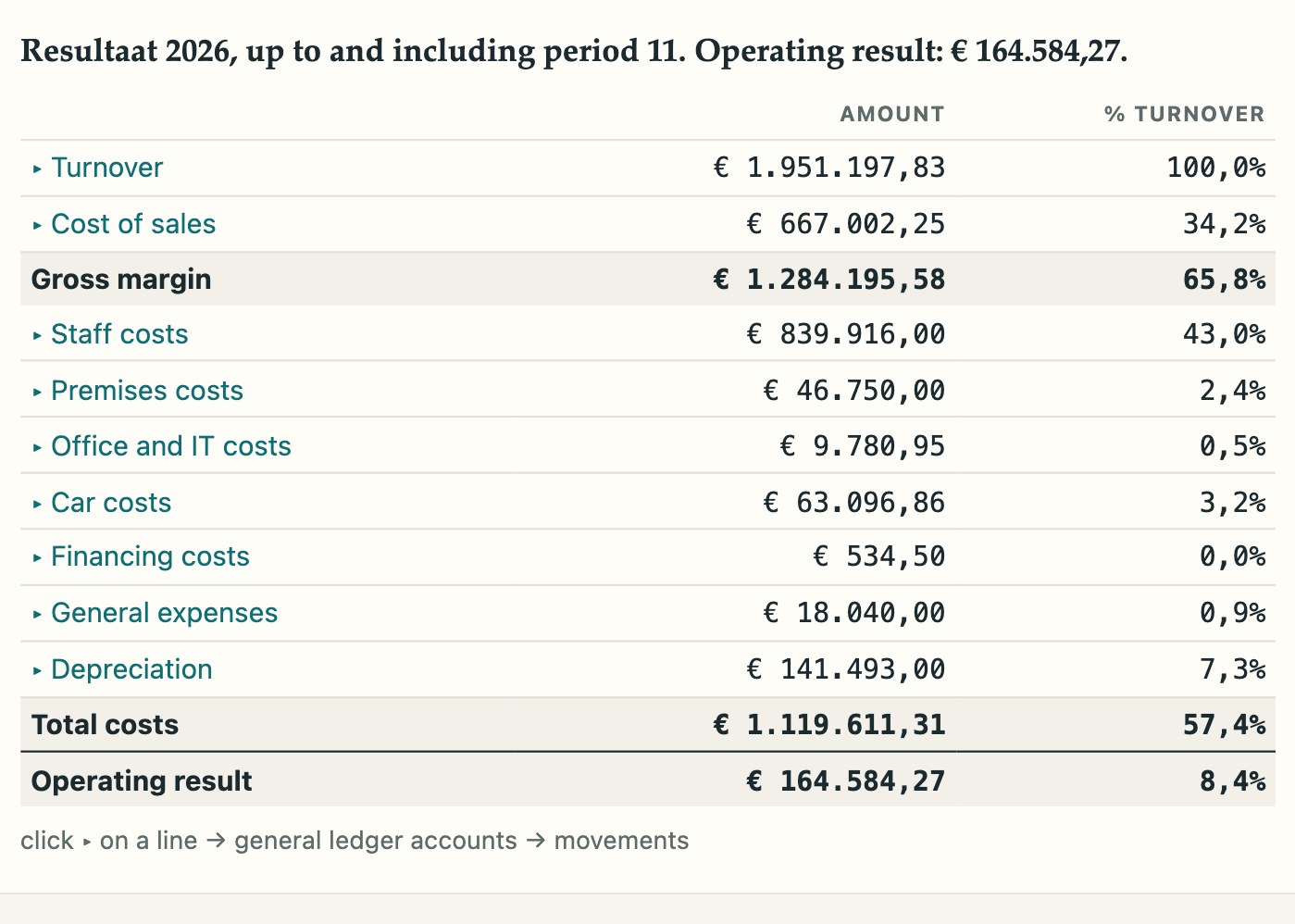
You carry on booking in your own bookkeeping package and import the auditfile as soon as the books are up to date. The cockpit checks it to the cent. Click a line, Car costs for example, and you see the ledger accounts that fall under it. Click through, and there are the separate entries that make up the amount. In two steps you go from the total to the one item you were looking for.
Your companies and your holding together
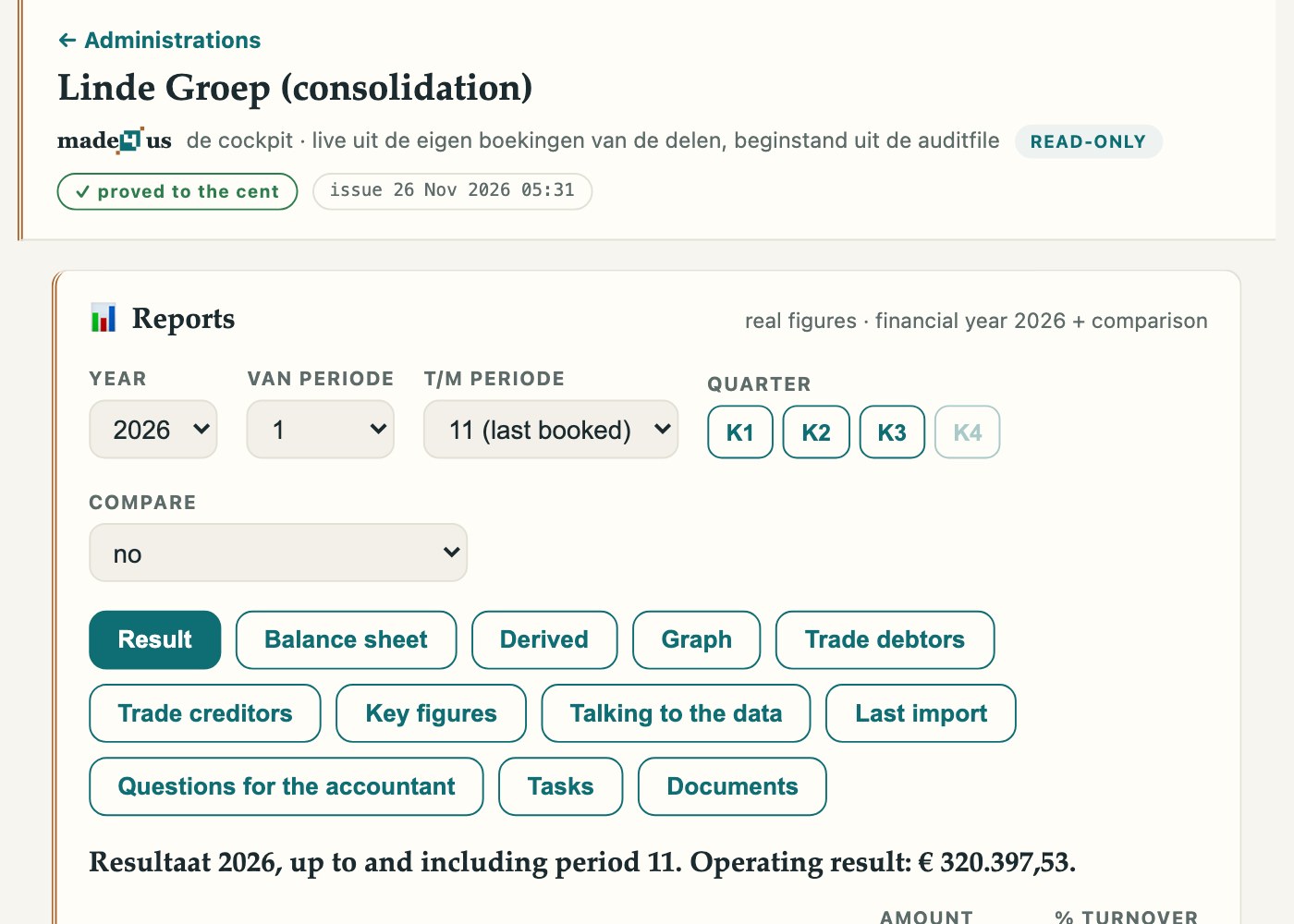
Fixed rules add up your operating companies and your holding. Nobody copies anything across by hand. Every button is a report on the whole group: the result and the balance sheet, under Derived the forecast for this year and the budget for next year, the chart, your debtors and creditors and the key figures. With Talking to the data you ask a question about your figures, and Documents holds the papers. Click a line and you see which company the amount comes from.
Private, with the documents
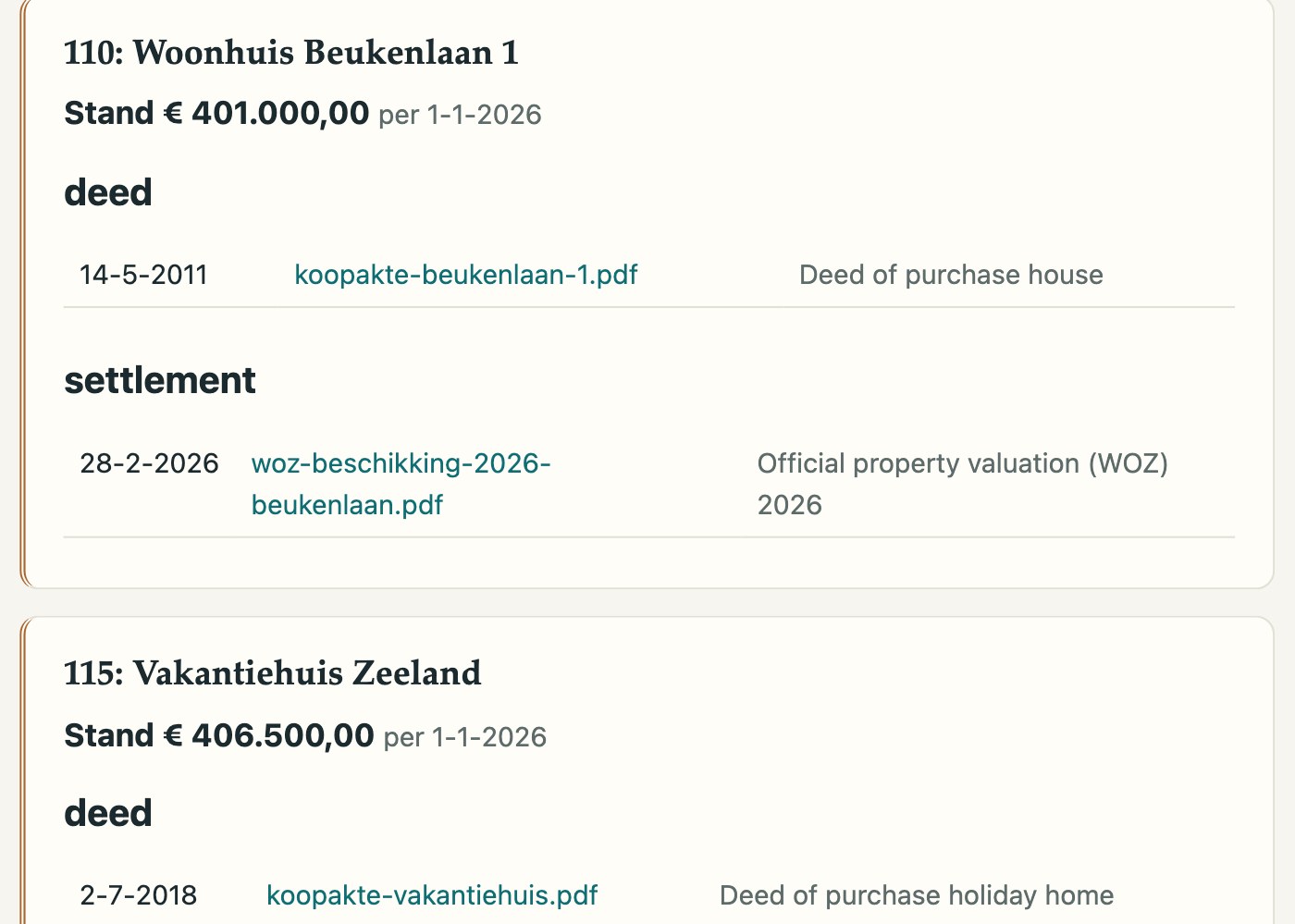
Every asset has its file: the deed of purchase, the property valuation, the policy. When someone asks for it, you find it here.
One figure: where you stand yourself
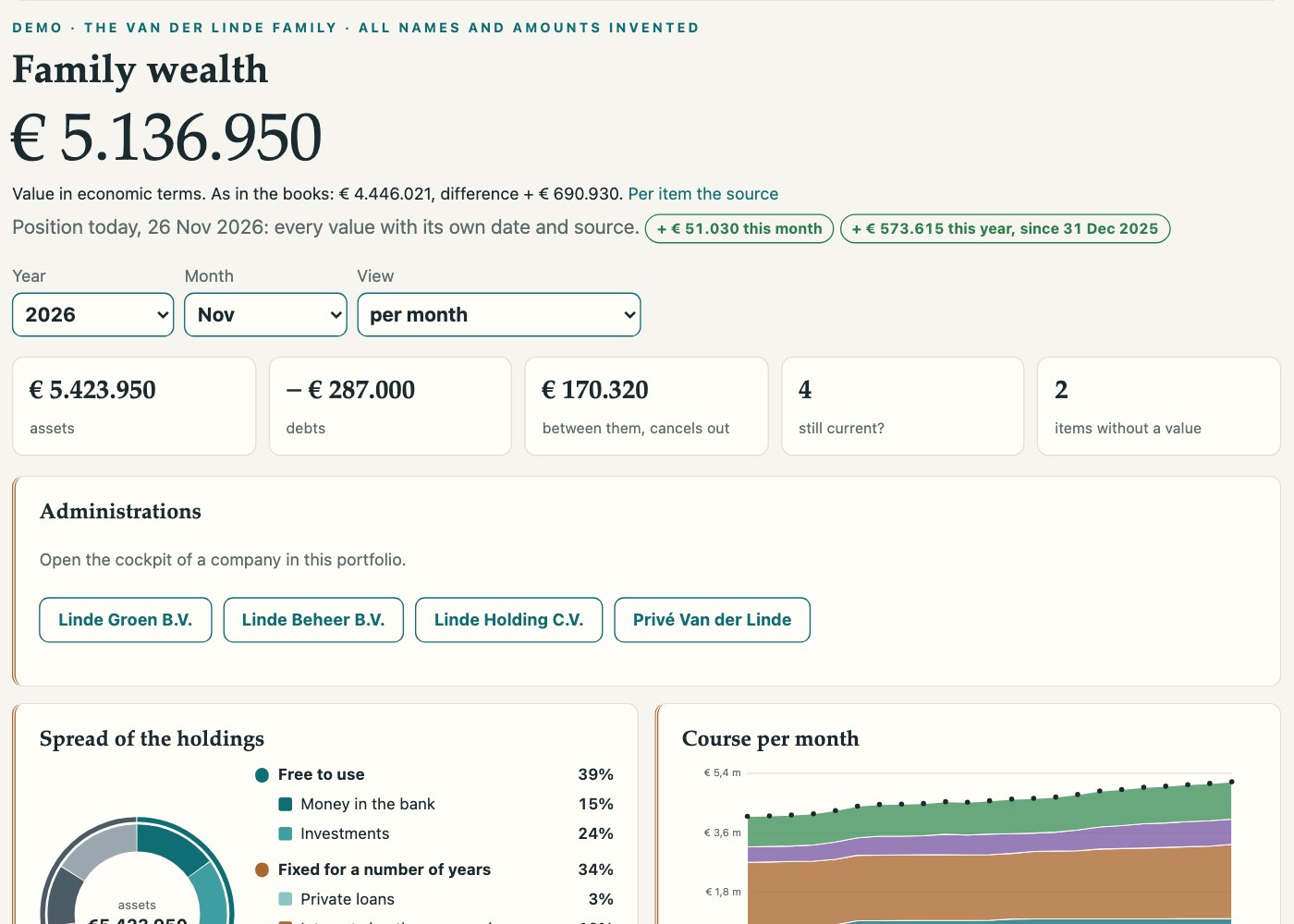
Companies, holding and private together. What you owe each other internally cancels out.
The screens come from the demo: a made-up family with made-up amounts.
What it costs you now
You know what your company earns, but not how you stand yourself
- You take big decisions on instinct, or on a sheet you have to keep up yourself: a house, an investment, working less, selling.
- What runs between you and your bv, you only see again when it comes up at the annual accounts. By then the year is already over.
- If the bank asks for substantiation, you go looking for documents you are certain you have.
- Your partner knows roughly how things stand. Roughly.
- And if something happens to you, your next of kin have to work it out, in the weeks when they are least able to.
What the cockpit puts in its place
Your company, your holding and your private side next to each other, with the documents attached
- You carry on booking in your own bookkeeping package. Once the administration is up to date, you import the auditfile; that is a standard file that almost every Dutch bookkeeping package produces in a few clicks.
- Your private administration comes from your bank statements, with your investments alongside. You forward the purchase notes, sale notes and settlements to the cockpit, and the position of your portfolio stays up to date.
- What runs between you and your bv, you see on both sides, and what you owe each other cancels out.
- A single figure for what you own and what you owe, every value with its source and its date.
- The documents filed with the item they belong to: contracts, policies, deeds and your will, business and private kept apart.
- Whoever needs to know can look along. Your partner, your children, your accountant, each with their own access.
And your accountant
They carry on doing what they do. The question is how often
The annual accounts and the tax returns stay with your accountant. If you book yourself in your own bookkeeping package, you are always up to date and your accountant looks along. If your accountant does the bookkeeping for you and you file a VAT return once a quarter, they usually also bring the books up to date once a quarter. That is how most firms are set up. Your overview in the cockpit is then as fresh as their last round.
If in that case you want to be up to date more often, there are two routes. You agree with your accountant that they bring the books up to date every month. Or you do the administration yourself in the cockpit, with Made4us Administratie: you email your invoices and receipts to the cockpit and they are booked the same day. What the cockpit can process itself, it books straight away; what needs approval, you approve yourself. Your accountant then keeps a finger on the pulse and does the returns: VAT, corporation tax and income tax.
Two ways
You choose how far the cockpit goes
Start with the overview and stay in your own bookkeeping package: that is looking.
If you want more, there is Made4us Administratie, and then you do the work in the cockpit itself. You make your quotation there. When your client signs, it becomes an order, and you send your invoice with a payment QR code on it. A subscription invoices every month by itself, and a payment is matched as soon as it is in the bank. You email your receipts and purchase invoices to the cockpit, you file your VAT return from it, and the bookkeeping follows by itself.
Switching is a small step: your last auditfile is the opening position, nothing has to be transferred. See what Made4us Administratie does.
What it costs you
You pay per company, plus one amount to see them together
Every administration costs 10 to 150 euros a month, by the number of lines: each company, your holding and private. If you want to see them added up, 50 euros a month for the group comes on top. You carry on booking in your own bookkeeping package.
An example: a holding, two operating companies and private
| Holding, up to 1,000 lines | 10.00 |
| Trading company, up to 50,000 lines | 60.00 |
| Installation company, up to 5,000 lines | 20.00 |
| Private, up to 1,000 lines | 10.00 |
| Consolidation of the group | 50.00 |
| Per month | 150.00 |
1,800 a year, for four administrations and the group view. Amounts in euros, excluding VAT, with made-up quantities.
What you want to know
The questions business owners ask us
How do I get an overview of several bvs in one dashboard?
Every bv carries on booking in its own bookkeeping package and delivers an auditfile every month, an export the package produces itself. The cockpit imports those files and puts your bvs side by side and added together in one overview. You do not have to switch for that, and you do not have to retype anything.
How do I consolidate the figures of my holding and operating companies without Excel?
The cockpit adds up the administrations of your holding and your operating companies from their auditfiles. A participation counts towards your percentage. Click an amount in the consolidated overview and you see the accounts and the individual lines it is built from, per bv.
Can I see my business assets and my private assets in one overview?
Yes. In the cockpit, your private side is an administration of its own next to your companies. The result runs from the operating companies through the holding to the private side, and you see the total on one screen. Business and private stay separate in the process: whoever may only see your company does not see your private side.
Is there software that reads along with my bookkeeping package without my having to switch?
Yes, that is what the Made4us Cockpit does. You carry on booking in your own bookkeeping package and your accountant carries on working the way they work. The cockpit only reads along through the auditfile and changes nothing in your administration.
How do I see every month how my companies are doing without waiting for my accountant?
If you book yourself, or your bookkeeper brings the books up to date every month, you deliver an auditfile per company every month from your own bookkeeping package. The cockpit turns that into your balance sheet, your result and your consolidated overview the same day. If your accountant brings the books up to date per quarter, your overview is fresh per quarter; if you want it more often, you do the administration in the cockpit, with Made4us Administratie. Your accountant's annual accounts remain the measure: if something differs from them, the cockpit shows that difference.
What is an auditfile and what can I do with it?
An auditfile is your complete bookkeeping for a year in one standard file. The Dutch tax office asks for it during an audit, which is why every Dutch bookkeeping package can produce one. One auditfile puts your administration in the cockpit, down to the individual entry lines.
Why you can believe the figures
There is forty years of experience in administrative organisation in the rules. The layout is your own annual accounts, not someone else's model. Click an amount and you see the accounts and the individual lines it is built from. A difference is shown and not smoothed away, and if a figure does not match its source, the cockpit refuses to show it.
And who are we? We are business owners ourselves, with several companies. The cockpit was built because we needed this overview ourselves, and we work with it every day. So what we show you, we use ourselves.
We go through it together on the invented Van der Linde family, with your questions alongside. Half an hour, and it costs you nothing.
Free training
Learn to work with Claude yourself
The cockpit was built with Claude, by someone who knows the trade and not the technology. You learn how in thirty short lessons, with examples for people who work with figures. The lessons are in Dutch for now.